Ceda Health Private GP Clinic recognises the need for environmental & sustainable development and continually aims to improve the environmental effect of its activities and reduce our carbon footprint. The purpose of this policy is to minimise our impact on the environment, while continuing to provide safe, high-quality patient care. We aim to reduce energy consumption year-on-year where practicable.
Our Commitment
Private GP Clinic is committed to achieving Net Zero emissions by 2045.
What does Net Zero mean in practice?
To achieve Net Zero, we will be aiming to reduce emissions in line with the latest science-based targets (SBTs). SBTs are greenhouse gas reduction goals set by organisations, they are defined as “science-based” when they align with the scale of reductions required to limit global temperature increases to 1.5°C compared to pre-industrial temperatures. To achieve Net Zero under this scenario, we will need to reduce our absolute emissions by 90% from our baseline year.
SBTi recommends that organisations commit to near-term targets (that cover a minimum of 5 years/maximum of 10 years from the baseline year), as well as long-term targets.
Our near-term targets:
Our long-term targets:
Emissions covered by our targets:
*Purchased electricity emissions are measured in two ways; the location-based method and the market-based method. The location-based method takes into account the emissions intensity of the grid from which the electricity was purchased, whilst the market-based method also takes into account the emissions intensity of the tariff and suppliers the reporting organisation has specifically chosen. The market-based method can therefore take into account purchases of renewable energy via a tariff. We have chosen to set targets and do final reporting using the market-based methodology.
Baseline Emissions and Current Year
Baseline emissions are a record of the greenhouse gases that have been produced in the past and were produced prior to the introduction of any strategies to reduce emissions. Baseline emissions are the reference point against which emissions reduction can be measured. We have chosen to set our baseline year as February 2024 – January 2025.
Baseline Year and Current year: February 2024- January 2025
The current reporting year (February 2024 – January 2025) is the first year that we have measured and reported our carbon footprint and will serve as the baseline year for future measurements.
All scope 1, scope 2 and scope 3 emissions have been measured using the operational control approach.
| Emissions | Total (tonnes CO2e) |
|---|---|
| Scope 1 | 2.6 |
| Scope 2 | Market-based: 3.4, Location-based: 4.3 |
| Scope 3 | 115.9 |
Carbon intensity metrics are calculated using total market-based results.
| Metric | Carbon Intensity |
|---|---|
| Tonnes of CO2e per Employee | 11.0 |
| Tonnes of CO2e per million of Revenue | 4.7 |
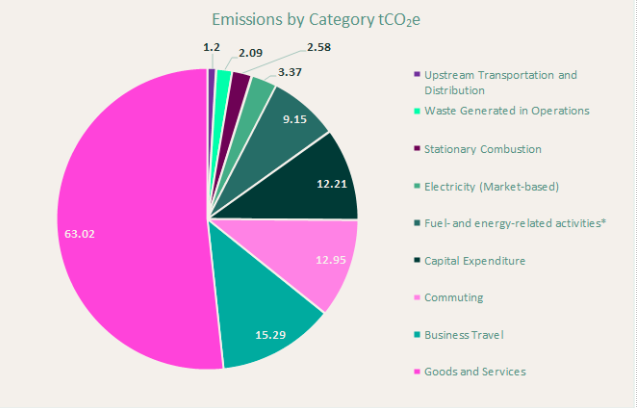
Of the measured categories, Goods and Services accounts for the largest share of emissions, with a total of 63.02 tCO2e. This category includes emissions from a variety of physical goods and services required to run our business, such as room hire, equipment hire, advertising and marketing. The second largest emissions source is Business Travel, which includes the travel accounted for by clinicians travelling to different clinic locations, which contributes to 15.29 tCO2e. The third largest category is Commuting 12.95 tCO2e and this accounts for the Autism Service staff commuting to the main office in Shrewsbury.
*Indirect energy emissions (GHG category; Fuel- and Energy-Related Activities) are those that occur upstream of energy use. In the other energy use categories e.g. business travel and employee commuting, we are accounting for the generation of electricity used or the combustion of fuels used. But these calculations do not consider the other emissions that occur e.g. the generation emissions of electricity lost in the transmission and distribution system or the well-to-tank (extraction, processing and transportation) emissions of fuels. To ensure we are measuring our full impacts, we have included these emissions for all scope 1, scope 2 (mandatory) and upstream scope 3 (optional) energy use activities.
| By Scope | Tonnes | % of Total |
|---|---|---|
| Scope 1 | 2.6 | 2% |
| Scope 2 | 4.3 | – |
| Scope 3 | 115.9 | 95% |
| By Category | Tonnes | % of Total |
|---|---|---|
| Office Utilities | 6.0 | 5% |
| Company Cars | 0.0 | 0 |
| Business Travel | 15.3 | 13% |
| Employee Commuting | 12.9 | 11% |
| Procurement | 75.2 | 62% |
| Distribution | 1.2 | 1% |
| Waste | 2.1 | 2% |
| Indirect Energy Emissions | 9.2 | 8% |
| Tonnes | % of Total | |
|---|---|---|
| Location-based | 122.8 | – |
| Market-based | 122.9 | – |
Our near-term targets:
Our long-term targets:
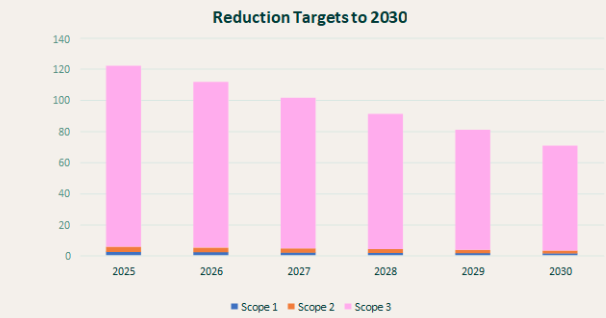
The graph below shows our total market-based emissions targets to 2030 based on baseline emissions. To achieve a linear reduction, we would need to reduce scope 1, 2 and 3 emissions by 8.4% each year. This would be a scope 1 reduction of 0.22 tCO2e, a market-based scope 2 reduction of 0.28 and a scope 3 reduction of 9.74 tCO2e each year. Once we have procured a 100% renewable energy tariff for electricity then our Market based scope 2 emissions will be zero
There is no progress on targets to date as this is the first year of measurement.
The following emissions management measures and projects have been completed or implemented.
| Activity | Completion Date | Scope |
|---|---|---|
| Commit to measuring carbon footprint of business activities year on year to gain an understanding of pinch points and regularly be making efficient and direct improvements to reduce these emissions. Year 1 appointed Positive Planet to support with calculating baseline carbon footprint and reduction recommendations. | 2025 | 1, 2 & 3 |
| Plans are in place to deliver Carbon Literacy Training to Staff in the Autumn 2025 and following the training to set up a green team. | 2025 | 1, 2 & 3 |
We are committing to action on the following emissions management measures and projects that are in line with our Net Zero targets
| Activity No. | Activity | Target Date | Category |
|---|---|---|---|
| Scope 1 & 2 | |||
| 1 | Encourage the landlord to consider alternatives to a gas boiler. To completely reduce market and location-based energy emissions to zero, install on-site renewable energy generation technologies such as solar PV panels, solar heating, heat pumps (following an energy audit to assess feasibility and payback periods), to generate 100% of heating and energy demand. Consider removing on-site stationary combustion (gas) heating. Look into these government funding: opportunities for heat pumps https://www.find-government-grants.service.gov.uk/grants/boiler-upgrade-scheme-1 https://octopus.energy/heat-pump-terms-and-conditions-may-2025/ | 2026-2027 | Stationary Combustion |
| 2 | Encourage the landlord to procure a 100% renewable electricity tariff. This change will reduce market-based emissions (from chosen tariff) from the office (common areas) to 0 tCO2e. | 2026 | Purchased Electricity |
| 3 | We will conduct a site energy efficiency audit with the aim of further minimising our consumption of energy where possible. We will do this using either an external consultant or ourselves using a tool such as Business Energy Scotland’s energy audit checklist. | 2026 | Purchased Electricity and Stationary Combustion |
| 4 | Total location-based electricity emissions (National Grid energy mix) are still 4.3 tCO2e so there is an opportunity to reduce energy use. We will implement behaviour change initiatives within the workplace for reduction of emissions, including clear messaging for turning off lights, monitors, computers, and other electrical appliances where appropriate. We will assign roles and responsibilities to Green Team members. High-level monitoring of energy use is key to understanding further pinch points. | 2025 | Purchased Electricity |
| Scope 2 – Suppliers | |||
| 5 | Implement a new Sustainable Procurement Policy. Encourage suppliers to adopt sustainable practices and improve their own carbon footprint through supplier engagement, procurement policies and contracts, and monitoring reporting mechanisms. Commit to a Sustainability Audit or Survey to request further information regarding suppliers’ sustainability credentials. With support from Positive Planet send these to the top 10/20 suppliers by spend. This data collection will support reduction journey by gathering important data for future measurements & encourage supply chain integration towards Net Zero. Complete this audit within two phases: Identify suppliers for engagement Formulate and collect data (survey/scoring) Once completed prioritise suppliers with lower carbon footprints as part of the above phased approach. This may also involve purchasing second hand/refurbished (furniture, IT equipment) and extending the lifespan of purchased items. Develop and monitor procurement policy for all new suppliers to align to Net Zero goals. | 2025-2026 | |
| Scope 3 – Company Culture | |||
| 6 | Commit to training the leadership team and other team members in Carbon Literacy Training and consider how this can be rolled out to the wider employee base. On average, certified learners reduce their carbon footprints by 5-15%, of which ~50% are work-related. | 2025 | All scopes and categories |
| 7 | Set up a Green Team to lead projects and initiatives across the organisation. Employees will need to apply to become a part of the Green Team and will be tasked with key responsibilities such as contributing to and executing our carbon reduction plans, educating colleagues about renewable home energy tariffs, Sustainable travel running communication campaigns about sustainability. | 2026 | All scopes and categories |
| 8 | Work to further embed sustainability into our company culture; this will include actions such as: Reviewing our company policies to ensure alignment with carbon reduction goals. Including a section on our website about our sustainability goals. Incorporate sustainability into our induction process. Embed sustainability into monthly meetings and newsletters. | 2025 | All scopes and categories |
| Scope 4 – Business Travel & Commuting | |||
| 9 | Develop and implement a Sustainable Travel Policy to support environmental impact of choices when travelling, staying in hotels and commuting. The priorities within this policy will support active travel and low emission travel options where appropriate. Commit to offering support to workforce with options for active travel schemes, such as bike to work or car sharing opportunities. Utilise the emissions travel hierarchy: Digital communication Walking and cycling Public and shared transport EV’s and car sharing/clubs ICE vehicles and car sharing/clubs Air travel Consider creative ways to engage and support the workforce to influence change. Examples include setting an internal organisation carbon credit scheme (limit that to a number of tCO2e per year), extra holiday days for low emission travel choice, bonuses, subsidised travel, equal mileage payments for diesel/petrol/EVs/cycling. | 2026 | Business Travel, Commuting |
| All Scopes | |||
| 10 | Commit to improving the quality of data year on year. Next year we will also provide an asset list for any electrical items including laptops. This will allow us to reduce the amount of spend data used in the footprint, increasing the accuracy, We will then be able to work out the Product Carbon Footprint of these products. Obtain higher quality data for water in m3. | 2026 | 1, 2 & 3 |
| 11 | Look at changing waste suppliers to be able to obtain more accurate data on the amount and type of waste and whether it has been recycled. | 2026 | Waste |

Emissions have been reported and recorded in accordance with the published reporting standard for Carbon Reduction Plans and the GHG Reporting Protocol corporate standard 1 and uses the appropriate Government emission conversion factors for greenhouse gas company reporting 2.
This Carbon Reduction Plan has been reviewed and signed off by Private GP Clinic, Executive Team.
Alison Turner
1 https://ghgprotocol.org/corporate-standard
2 https://www.gov.uk/government/collections/government-conversion-factors-for-company-reporting
West Byfleet Health Centre
Ground Floor
Madeira Road
West Byfleet
Surrey KT14 6DH
01932 344004
Private GP Clinic, Sunningdale, (Opposite Fego’s)
3 Broomfield Hall Buildings
London Road
Sunningdale
Ascot
Berks SL5 0DP
01344 624020
Private GP Clinic
Stanton House (on one-way to Reigate Centre)
1 Castlefield Road
Reigate
Surrey RH2 0SA
01737 238688